Generation V release day
It’s 12:30am, and it’s the release day of my debut book.
This is a good day. I worked a very long time to make this happen, and it definitely wasn’t easy. I’m hoping a lot of things right now — that the book is well received. That people are excited about my characters. That the book does well financially. I’m thinking about these things, and those thoughts have been present basically since the book found an editor, but most of all today (and it’s still really tonight) I’m feeling really grateful.
I’m grateful to my teachers, who taught me how to hone what was good and cut what was weak.
I’m grateful to my husband and family, who gave me tremendous support.
I’m grateful to my friend Sarah, who was the first person I ever showed the draft of Generation V to. She read about three versions of the book.
I’m grateful to friends who gave me good career advice, and listened to lots of my whining.
I’m grateful to my agent, Colleen Mohyde, who worked so hard for this book.
I’m grateful to my editor, Anne Sowards, who liked the book enough to take a chance on it, and then did so much to help me make it stronger and better.
I’m grateful to all the people at Penguin and Roc who put their time and talents into this book — particularly the cover art team, the copy editor, and Brad from publicity.
I’m grateful to all the friends I made among other writers while I was tweeting and posting while waiting for the book to come out, many who were incredibly generous with their time, advice, and passing the word about this book, especially Michael J. Martinez, Django Wexler, and Barb Hendee.
And I’m so very deeply grateful for all the bloggers and review writers who read the book and got excited about it — Julie from Yummy Men & Kick Ass Chicks, Candace from Candace’s Book Blog, Tori from Smexy Books — and all the other dedicated and wonderful bloggers and reviewers who gave so very generously of their time and platform to help give my book the best possible start — just a few among them are RT Book Reviews, Kirsten at A Book Obsession, Abigail at All Things Urban Fantasy, Sally at The Qwillery, Carolyn at Book Chick City, Kristen at My Bookish Ways, Theresa at Fade Into Fantasy, Star at the Bibliophilic Book Blog, Angela at SciFiChick.com, Kristie at Dark Faerie Tales, Stacy at Urban Fantasy Investigations, and Amy Phelps at News & Sentinel.
Thank you all, so very very much.
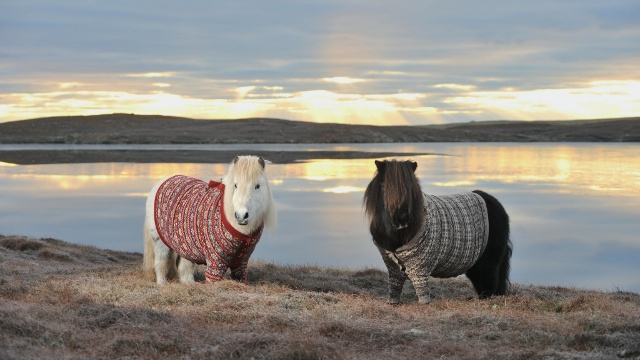
You are the cardigan to my shetland pony.
The shetland pony might be able to exist without a cardigan, but the pony will be far, far poorer for its lack.
Five days to go!
Only five days to go, and things are incredibly exciting and busy for me! The very nice publicity rep at Penguin gave me a list of every blog that he’d sent an advance copy of Generation V to, and I contacted a bunch to ask if it would be possible to do an interview, or a giveaway, or some kind of guest post, and everyone has been hugely supportive and wonderful. So I have a lot of stuff coming up the pipeline (including some really fantastic interviews that were so much fun to do) over the next week or so.
Exciting stuff for today:
Check out the Top Ten list I did over at All Things Urban Fantasy. They are also hosting a giveaway, so if you would like to win a free signed copy of Generation V, check it out there!
Everyone should also check out Kirsten’s review of Generation V over at A Book Obsession. Four out of five butterflies can’t be wrong!
I’ll be posting again tomorrow, but for now — wouldn’t you like to pre-order Generation V? You know that you would!
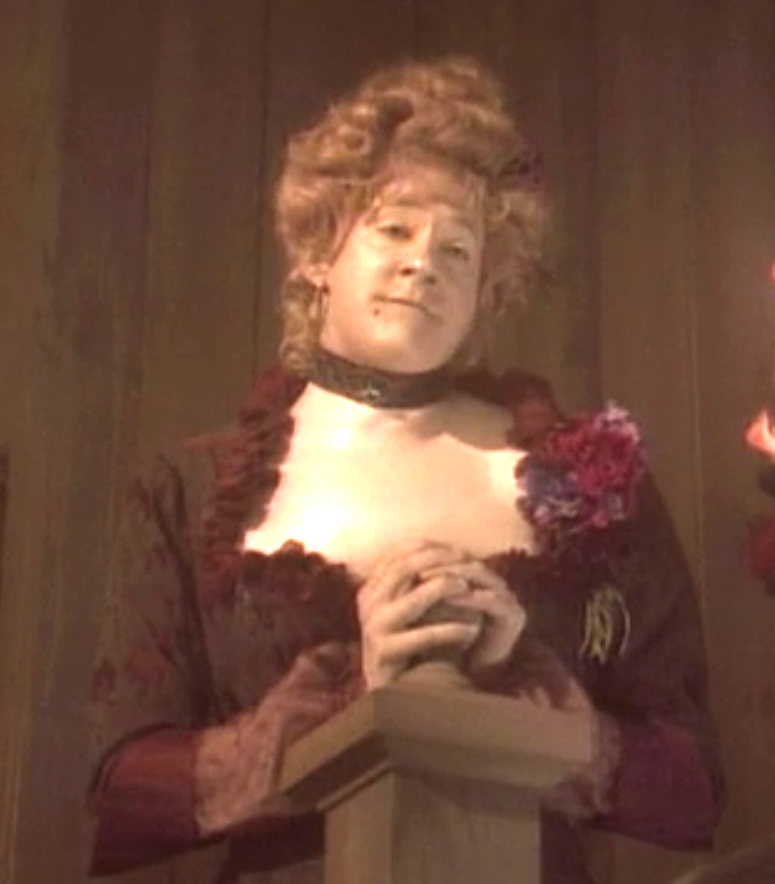
Cross-dressing Data wants you to pre-order Generation V.
And you should.
Because he’s cross-dressing Data.
rejection
Really great post by Carrie Vaughn that shows her pile of rejection letters. I had a giant file like this as well, until eventually I was running low on file cabinet space and made a purge. Now I just have a huge file folder that has my rejection letters that had ink on them.
But I think this is great, because it isn’t about how big the pile is. It’s that you keep writing, keep getting better, and keep working, and eventually you can get the “yes.” And all you really need is one yes.

I’ve talked about doing this, so here it finally is. My folder of rejection slips:

(With handy dinosaur ruler for scale. That’s over three inches of paper there.)
These aren’t all the rejections I’ve gotten. This doesn’t include all the e-mail rejections, which are quite legion. Or any of the rejections I got before 1995, which are hidden away in some folder I haven’t rediscovered yet. (I started sending stories out in about 1989). The most recent rejection in this pile? Spring 2012. Yup, I still get rejections. People sometimes ask me how many rejections I’ve gotten, and I’ve never counted. I have no intention of counting them now. Just estimating, based on how frequently I was sending stuff out during my busiest submission period (roughly 1995-2006), I have upward of 600. I know this stack is taller than a ream of paper, which is 500 pages. But you know…
View original post 262 more words
How I Built My Vampires — Part One, Apex Predators
Two weeks until Generation V is on the shelves! This is amazing, because I can try and work it into conversations in a very fake-casual kind of way. “Oh, week after next? Well, I have that dermatologist appointment, and then I thought I’d swing over to the bookstore. No big deal. Thought I’d buy Munchkin Chtulhu… and MY OWN BOOK THAT GETS PUBLISHED THAT DAY!”
Very exciting times right now. Advance copies of Generation V have gotten three really nice reviews on Goodreads, which everyone should go and read. Here’s a snippet of what David Caldwell wrote about Generation V:
This isn’t your typical vampire/shapechanger novel.The author has come up with a new and creative take on vampires.The idea of the host is great and gets rid of a lot of the problems presented in most vampire tales.Vampires aren’t immortal, just very long lived.They continue to grow strongeras they age.They also gain many of the weaknesses(like having to avoid the sun) as they age.
And Matt Lunn:
M.L. Brennan develops a very likable hero and excellent surrounding characters to go with an interesting new take on old vampire myths.
And Django Wexler (full disclosure, I know Django, and his first book The Thousand Names is incredibly cool and amazing and I reviewed the crap out of it already.):
It’s always nice to see an original take on the vampire mythos. (Including, for once, a reason why vampires haven’t overrun the world!)
I’ll brag a little here – all three of those reviewers also gave me five out of five stars. (fact: I am going to bawl my eyes out the first time someone give a nasty review)
But what all three reviewers were talking about was the way that I reimagined and rebuilt vampires in this series, so I thought that this could be something useful and interesting to blog about today.
Firstly, I’ve always had a bit of an issue with the vampire myth as it usually plays out, for pretty much the same reason that Django refers to – if vampires are immortal and all they have to do to make more of themselves is bite someone, have that person drink a little bit of blood, and then you have another vampire? You have a massive population control problem that will fairly quickly result in the entire world being covered by vampires!

You can actually see this play out by watching The Vampire Diaries. At this point, basically all the original humans are now vampires. Or dead.
I knew before I even started planning the series that I wanted my vampires to have a lifespan. Because, let’s face it, immortal characters are boring. They have no life cycle, they have no particular stake in doing anything. But then there was the question of what kind of life cycle? I didn’t want this to be a thousand years kind of thing, because then you’re only ever within two generations of the time of Christ, and honestly, that’s a little weird to think about. “Oh, that guy? Yeah, my grandpa was drinking buddies with him. Man, did that Nazarian like to put back a few bottles of wine.”
I also really didn’t want a protagonist who was a few hundred years old. Unless I made it a completely separatist society, the vampire would have a really tough time rolling with the constant changes in time. And half of his memories would involve women in corsets, a lack of flush toilets, and the days when Mozart’s music was banned for being too racy.
When I started constructing my vampires, I wanted them to make sense in a biological way. Not a lot of sense, granted, since this is still fantasy and my field of study was in the humanities, but just enough that I felt like I could work with it.
My first step was to think about how vampires would fit into the natural world. Essentially we’re talking about an apex predator in its ecosystem – big, in charge, eats what it wants and no one eats it.
Vampires are basically Great White Sharks.
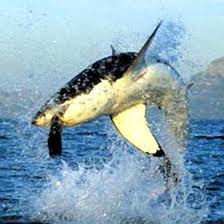
For reference – in this parallel, humans are that seal
Now, Great White Sharks are amazing, and badass, and the entire reason behind Discovery’s Shark Week. But like all apex predators, they are also inherently vulnerable because of this important fact – prey species must reproduce quickly, because it’s through sheer numbers and fecundity that the species can continue, since just about everything eats them (think bunnies here). But apex predators are different. For one thing, it usually takes them much longer than their prey to reach maturity – both physical maturity and then sexual maturity. After all, nothing is eating them, so what’s the rush? Secondly, they tend to reproduce less often, and in smaller numbers, because, again, no one is eating them, so no worries.
Which is fine… as long as nothing effects that ecosystem.
Here’s the thing about an apex predator – they are far more vulnerable to changes than their prey species. They are also far easier to wipe out, because of those important traits – slow to mature, slow to breed, and then they produce small numbers of offspring.
This takes us back to the badass Great White Shark. We don’t know a whole hell of a lot about them, but we do know that they live 30+ years, and that they don’t reach sexual maturity until around year 15. They also have an eleven-month gestation cycle, and deliver between 2 to 14 live pups, which then swim off and have to fend for themselves while they get bigger.
That long maturation period and relatively low amount of young makes them very vulnerable. For example, if suddenly another species comes along with boats and the interest in sport-fishing them and/or making tasty soup out of their fins, a huge dent can be made in the population, and this is a population that can’t bounce back very quickly.
And that led me to an idea I really liked – that vampires were a species that was barely hanging on, because the long maturation period and the low birth rate had been a disaster once humans began developing technology that could offset the natural power imbalance between them. Imagine a rabbit vs. a wolf. Now imagine if the rabbit is carrying a rabbit-sized AK-47. Those big teeth don’t make such a difference now, do they?
So vampires are strong, and powerful… but it takes them a while to get that way, just like baby Great White Shark. And if normal humans (the rabbits) traditionally reach sexual maturity around 15-18, then my vampires don’t hit it until they’re around 250. And the birthrate is very low – usually between one or two offspring in a regular vampire’s lifespan.
Now my primary vampire, Madeline Scott, is unusually fertile in the vampire world. Her oldest is Prudence, who was born in 1775. Then Chivalry in 1864. Then Fortitude, who is now 26. And none of her children are old enough to either leave home or start a family themselves, though Prudence is getting close.
To me, that seemed both interesting and plausible that this was a species that A) hadn’t overrun the entire world, and B) could be pushed right up to the edge of extinction.
But most importantly, C) would be neat to write about.
That was how I imagined I used the idea of vampires as apex predators to construct my species. But I also had a second way of interpreting vampires, which I’ll go into more next time –
Vampires are apex predators. But they also are very specific predators, feeding solely on the blood of another species. Which to me made them…
Parasites.

And this was when the vampire lifecycle started getting interesting…
10 Concrete Ways To Help After A Disaster
It’s hard to know what to do with yourself or how to feel after a disaster like this, which is why I think blog entries like this are so important. The Belle Jar has presented it beautifully, so just go ahead and read:

I was sipping an overpriced americano in a small, aggressively hip coffee shop today when the news broke about the bombing at the Boston Marathon. I’d only meant to sit down for a few minutes, but ended spending over two hours there nursing my cold coffee and obsessively refreshing my Twitter feed.
Sitting there, I had the surreal experience of watching a disaster unfold in real time on social media. What made it even more strange was the fact that I was surrounded by people who had no idea what was happening. Two girls across from me discussed their upcoming Vipassana retreat and had a passive aggressive competition about their current meditation practices. A girl next to me was reading The Feminist Porn Book and occasionally making furious notes in her Moleskine. A young boy and his grandmother seated on my other side tried to figure out his math homework.
View original post 1,369 more words
Guest blog
I’m guest blogging at The Qwillery today. This is a topic that I’ve actually spent a lot of time thinking about, which is “The Weaker Protagonist.”
At the start of Generation V, Fortitude Scott is a guy whose life is sucking and who has no intentions at all to be heroic. Forget saving the world, he’d just like his roommate to pay his half of the rent — and Fort can’t even make that happen. In an early chapter, Fort is mugged by Bruins fans.

In fairness, some Bruins fans can be dicks. But not you, of course. You are a Bruins fan for all the right reasons. Because of the skill and athleticism displayed in the sport. You sniff judgmentally at those who go just to see the enforcers beat someone up. You watch for the *strategy,* and drink only in moderation.
But that’s what I like about Fort — because he’s not some super-powerful guy who can wipe out continents with a thought while also practicing his kung fu that would make Chuck Norris weep. He’s a guy with a film degree and a minimum wage job, yet he’s thrust into circumstances where he chooses to act heroically.

So pre-order my book. And if you have moral objections to Amazon, it’s also available from Indiebound!
One month to liftoff!
You know that feeling you start getting when you are little and you’ve just finished off the last of the Thanksgiving turkey? The knowledge that in just a month, you are going to be running downstairs and seeing a pile of presents under the tree with your name on them?
That’s what this feels like. Giddiness, impatience, and the wish that you could just skip the next month.
You know that feeling you started getting when you were a senior in college, and the order form arrived for your graduation gown? That knowledge that in just a month, you were going to march in a line, wave to your family, and then be expected to find a job in order to start paying off those massive student loans?
That’s also what this feels like. Anticipation mixed with fluttery gut-deep nervousness, and a vague apprehension of what’s about to happen.
I’m simultaneously in two very different emotional landscapes. It took a lot of years and hard work to get to this moment, so I’m very intensely desperate to see the fulfillment of Generation V sitting on a bookstore shelf. On the other hand, I have that nervous worry – what if no one really likes my book? But then I remind myself that if the book truly sucked, then my editor wouldn’t have bought it in the first place. Plus, Devon Monk and Karen Chance both said very nice things about the book, and I never even met them! Which helps for five minutes until I start thinking about the possibility of seeing one-star ratings on Amazon.com. But then I think about how nice it would be to see five-star ratings.
It’s awesome and complicated at the same time.
Some good things:
The Goodreads giveaway of Generation V closes in two days! 25 copies of the book will be given away, and right now there are 627 people requesting – so that’s pretty cool.
Generation V got its first review! You can go over to RT Book Reviews to check it out – heads up, though – you can only see the review if you are a subscriber to the magazine. Two months after the print magazine hits the stands, everyone will be able to read the review, but for now you need to be able to log in. But I got a peek, and the reviewer, Bridget Keown, gave it four and a half stars out of five, which I am assured is a big deal for a debut! (and Keown used the word “sensational” to describe Generation V!)
I’ll be guest blogging at The Qwillery next week as part of their 2013 Debut Author Challenge, and there will also be an interview posted the day after Generation V hits the stands (May 7th!)
Finally, my author copies arrived – the book looks AMAZING! I’ve included pictures below! (oh, if you run a blog or a website and would like to review Generation V, please email me and I’ll send you a copy!)
It looks good coming…
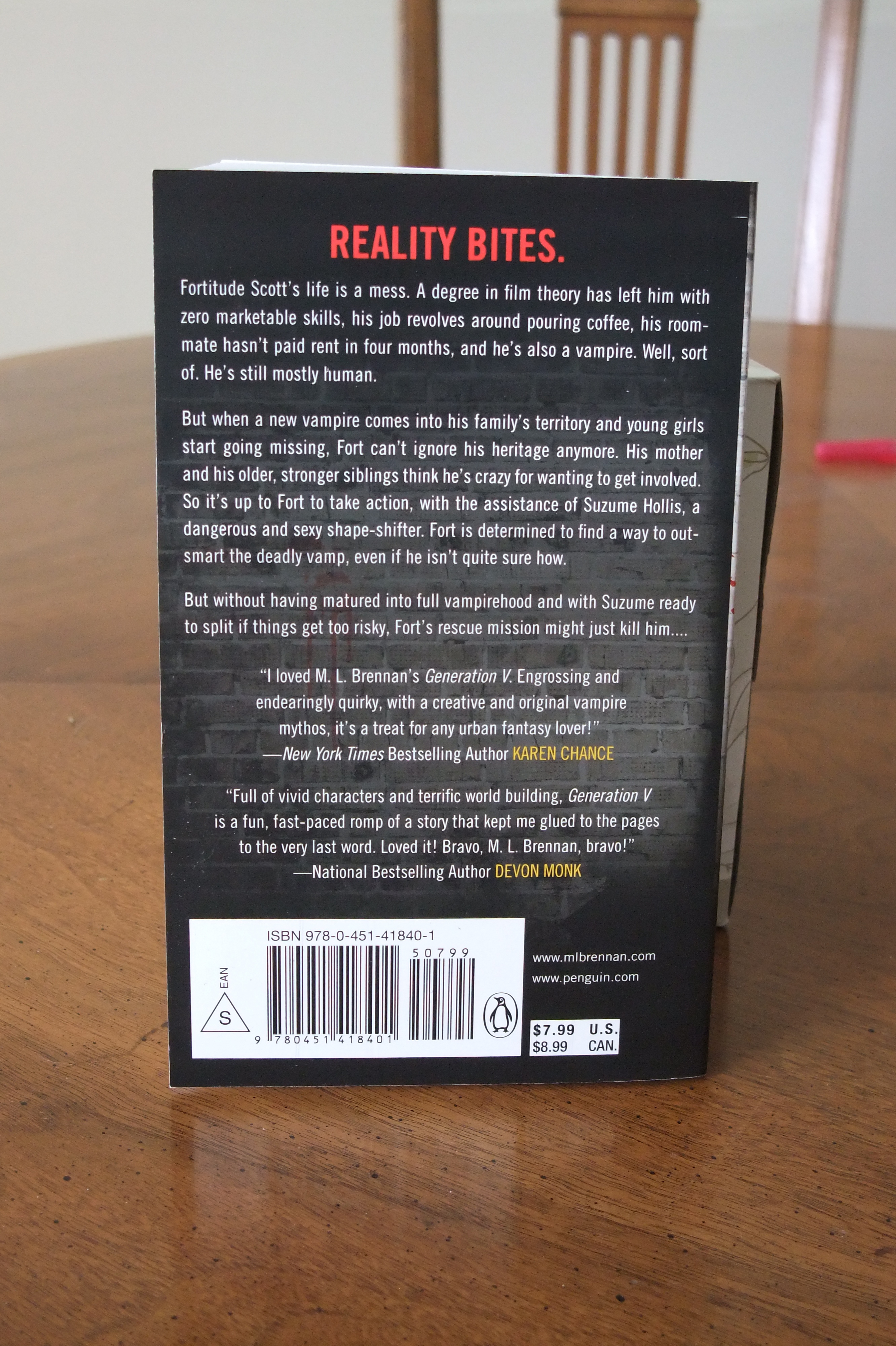
… and it looks good going!
Generation V Giveaway!
Less than two months to go before Generation V is available in bookstores everywhere, whether brick and mortar or online! May 7 is the magical date, for those of you who *haven’t* inscribed it on every available surface. Fun secondary fact – it turns out that this is also the release date for the conclusion of Charlaine Harris’s Southern Vampire series – so if you’re going to be in the bookstore anyway to buy Dead Ever After, why not buy Generation V while you’re at it? Or, if you’re buying it online, throwing Generation V onto the order will get you (almost) to the $25 minimum for super saver shipping!
There have been some fun developments as the debut gets closer. For one thing, Generation V now has a Goodreads Giveaway! Link is here. Twenty-five advance readers copies, so that’s pretty exciting. Even more exciting – if more people sign up for my giveaway than for my friend Django Wexler’s epic fantasy The Thousand Names I will have total bragging rights. (Fact: I am horribly competitive, and so is my brother. It has gotten to the point where our mother refuses to play board games with us anymore unless our spouses are also involved.)
A few other things are brewing, and hopefully I’ll have more to say about those shortly. Apparently the ARCs have also been circulating among the trade magazines, and I’m starting to hear that the book is getting some good reception. I’ll talk about those a bit more at a later date, hopefully when I have links for reviews.
A blog called The Qwillery has included Generation V in their 2013 Debut Author Challenge. I really like this idea, and I’m excited to get to be a part of it. I’ll get to do a guest blog on the site in April, and then they’ll be posting an interview with me the day after Generation V’s pub date.
That’s mostly tying things up. The last few months I’ve been keeping my hands busy by working on the sequel to Generation V. That’s with the editor now, so I’m occupying myself now with planning major events for Book Three. More details on those will come later, but I’m very eagerly waiting to see what people think about Generation V.
But as I’m biding my time until the day that I can go to Barnes and Noble and take photos of my book on the shelves (fact: I’ve already gone and admired the spot where it will be), here’s what I’ll be doing on March 30th!
Self-Publication
It’s now just under four months until Generation V will be published. (In case I was too subtle on that: May 7! Pre-order is available at many fine online establishments!) Here’s something that’s kind of funny about being almost-published – you find out just how many people around you would like to publish a book. From my mailman’s niece to the boss of a friend of mine, when the people you know start saying “Hey, my friend is about to get published,” suddenly you become someone people would like to talk to.
This is very different from the response to “Hey, my friend is writing a book,” because then everyone is just coming up with reasons why they really really don’t want to read a draft of it. (For the record – I don’t blame them. Two friends read my drafts. I do not envy them this – they have to tell me what isn’t working in harsh enough terms that I put on adult-sized pants and deal with the issue, yet at the same time validate me for the six months I just spent wrapped up in creating this manuscript. It’s stressful.)
But one of my friends knows someone who has written a manuscript, and who wanted some advice on publication. She’d been talking with someone who self-publishes, and his advice to her was geared toward that line of publication. He even was nice enough to suggest who she could employ to edit the book and design a cover.
Here was her question, which I’m going to post since I have a feeling that it’s a question that a lot of people looking at a freshly completed manuscript end up asking themselves:
Since I’m new to this scene, I wanted to get some more information on the benefits of self-publishing vs. trying to get a literary agent which I know can be very difficult. Any words of wisdom? Do you mind me asking how you got started?
I’ve written about my path to publication before, but I never really addressed my own decision not to explore self-publication. Plus I spent about two hours writing my reply email, so I’ve decided to put this up. I know that there are a lot of strong feelings both for and against self-publication, and that this topic has a lot of nuances to it, but here are my thoughts on the issue, and the advice that I would offer to people considering it for themselves.
I’m clipping the first part of my letter, which was about stuff more specific to her, but I’m posting the rest as I sent it to her.
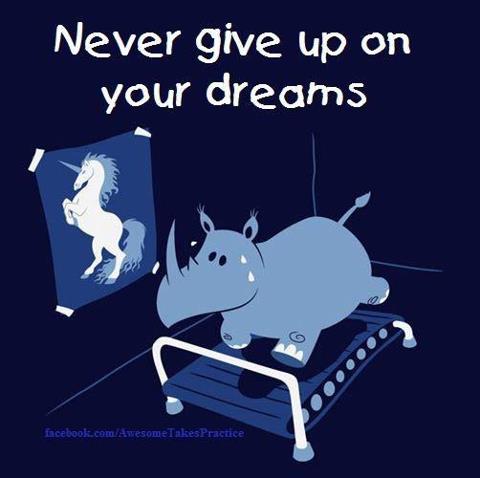
I think this goes with the general gist of my feelings toward publishing. The odds may be long, but I think it’s worth trying for. Run, hippo, run!
Firstly, I’ll explain my own position about self-publishing — I know that it has gained much more credibility in the last few years, and that it is no longer limited to the standard “vanity press” — there are also a lot of examples lately of people who didn’t have luck getting something published through traditional means, published themselves, and found success.
That being said, when I was working toward getting published (and it did take me a few years), self-publishing was never something I even thought about trying. Was getting an agent hard? Yes, it was. I cold-queried over sixty agents before I found mine — some of them never responded, many sent me form rejections, several read parts of my manuscript and thought about taking me on, and a few even came very close to taking me.
And getting an agent is no easy pass to publication either, since then your agent tries to find your book a publisher, which is just as difficult. My book is going to be published in May — it is not the book that I got my agent with. The book my agent originally represented (the book I spent three years writing, trying to get an agent with, rewriting with feedback I’d gotten, and then finally got her with) never sold, despite my agent’s best efforts. So I sat down and wrote a completely new book. And it also took my agent about seven months to find this book a home, and it was rejected by enough publishing houses that I’d actually just sat down to start writing a third book when my agent gave me the call that we’d gotten a nibble of interest.
But during that time period (which stretched about four years from the first time I sent a query to an agent to when I signed a contract to sell my book) I never thought that self-publishing was a better option. And I’m even more confident about that decision now. I’ll walk through that process again:
I wrote a book that I loved and that I was extremely proud of. I’d already gone through two major edits, and it looked good. If I was self-publishing, I could’ve taken that book (which I was happy about) and jumped immediately to the parts like hiring someone to edit, hiring someone to do a cover, and trying to do self-promotion.
It wouldn’t have been the best thing I could’ve written. The agents who turned down my manuscript gave me a lot of very valuable criticism. I probably sent it out to forty agents before I decided that the manuscript needed to be overhauled. So I stopped submitting and took six months and reworked the book again. It was hard, but the book was a lot better when I was done. I sent it out to all the agents who had responded to my original query. None took the book on, so I compiled a new list of agents and started sending out. That was when I found my agent, Colleen Mohyde.
That’s the thing — one query or a thousand queries: all you need is one person to say yes. If you have a good, solidly written book, then someone will say yes. Also, the thing about an agent is that she doesn’t get paid until you do — it’s in her best interests to make sure that she gets you the best possible deal on the best possible terms. Short of one-shot celebrity memoirs, every agent is working to build an author’s career. Colleen worked with me for two years before she got a paycheck out of it.
So Colleen then took my book and sent it out — starting with the top publishing companies, then working her way slowly down the list to small independent presses. This took one very long year, with a lot of rejections, a few nibbles of interest, but mostly rejections. It became really clear that the book wasn’t selling — so during my summer break from teaching, I sat down and wrote another book. I gave it to Colleen, and she began the same process that she had with the first, complete with a number of rejections — except this time it sold, and it sold to [Roc]. Definitely a big deal. And, again — it didn’t matter how many people ultimately said no, as long as one person said yes.
So I sold a manuscript that was 74,000 words (and here is where Colleen more than earned her 15% — on the contract negotiation), and a book that I loved, my agent loved, and my editor loved.
What is getting published is 85,000 words. My editor and I went back and forth on three through edits — one largely structural, and two more precise line-edits. I cut some things, adjusted some things, and ended up fleshing out and adding a lot more. I can say without a doubt — everywhere my editor touched the manuscript, it got better. She questioned things and challenged several others, and it pushed me to improve what I’d thought was good and make it better. I wasn’t employing my editor — we were working together on a project that both of us believed strongly in, and that we were both trying to make as good as it could be. Because she also had a bit of a position of authority over me, I never had the out of saying, “Hey, I just want to leave it like that” — if I didn’t agree with an edit, I had to work elsewhere to correct the issue she was noting. She was able to do her job, and that was pushing me to write as well as I could — and beyond where I would’ve left things on my own.
Once my editor was satisfied with the result of our labor, it was passed over to a separate copy-editor. This person had no emotional stake in the manuscript like my editor or I did, and a month later I was presented with his notes. These were mainly focused on grammar and continuity (things that I’d already worked on with the editor, but now these were even more precise), and I worked on those and returned the manuscript. It then went to a typesetter, who put together an uncorrected proof. These pages were sent to me and to a completely new proofreader to make sure that any last grammar issues or typos were caught — and this is a fact: even after it had been through this many edits and hands, I found 10. I don’t know yet if my proofreader found any others.
After this round the book will be adjusted, rebound, and advance reader’s copies will be sent out to try to solicit some more good reviews. When I first finished the initial edits, my editor sent the manuscript to a bunch of other (bestselling) authors to try to get blurbs for the front cover — I got two from bestselling authors in the field. If I’d just sent an e-book to them, I have no doubts that they never would’ve read it.
Because I’m a new author, not much money (comparatively) will be spent on publicizing my book — that’s just a fact of the publishing world today. So I’ve been setting up a website, blogging, trying to bring my book to the attention of people who could help publicize it — all the stuff that any writer will do as self-promotion. But in addition to what I am doing, my agent is doing everything she can to promote it, and so is my editor, and there’s a general publicity department over at Penguin that includes information about my book in their press releases. Whenever I find a website or blog that devotes itself to reviewing books, I fill out a form on their site to request that they review my book when it comes out — and the truth is that many of them specify on the form that they aren’t interested in self-published books.
The cover of my book is amazing — my editor asked me to send her a list of covers I’d seen that I liked so that she could get a sense of what my tastes were, but she also let me know at the start that they would be putting together a cover to sell the book, not to please me. A team worked on it, with my editor very involved, and when they showed me the result I was blown away. Was it what I’d pictured? Nope. It’s not what I would’ve designed either. But I’m not a graphic designer — I’m a writer. Not having to worry about the cover, or pick someone to do it, meant that I had more time to write. Plus, the cover that I was presented was something that a whole group had worked on.
This is running crazy long, so let me ultimately sum this up — if you’ve written a book that you are proud of, and that you worked hard on, I think you owe it to yourself to try and get it published through the biggest platform available to you to showcase this work. Good books are self-published — I’m not denying that. But so are a whole lot of bad books that are poorly edited and have very cheap cover design. And even if your book is amazing, and you employ a great editor who will be honest with you about every change that needs to be made and will go back and forth with you through as many edits as necessary, and even if you get a great cover artist who designs an amazing and professional cover (and that can absolutely happen!), here’s the thing:
1) You are putting a very real financial investment into this book beyond what was even required to write it — the editor, the cover artist, whether you then also employ a copy-editor and then a final proof-reader, plus the publication itself. Will it be faster than if you went traditional publishing? Yes. You will also rest assured that you will see your name on the cover of a book, which is a promise no one can make to you if you pursue traditional publication. But I never wrote a single check or handed out a dollar to anyone in that long process I described to you — it was long and hard, but when money came, it came to me, not from me. My agent and my editor are invested in the book — that’s where their payout will come from — not from whether I’ll write them another check.
2) There will be an asterisk next to your book if you self-publish. This isn’t a scarlet letter, but it means that the strength of your writing will have to overcome assumptions. Even as self-publishing is getting more and more acceptable, and the barrier of brick and mortar bookstores becomes less important in sales, this is a fact that will very seriously remain, and for this reason:
No matter how much you put into this work, and how good you *know* that it is, this fact will remain: a five-year-old can self-publish. All it takes is someone standing next to them with a working checkbook, and their book will sit right beside yours. Publishers deal with the slush pile — these are unagented manuscripts that are sent in by those dreaming of publication. Famous books have been pulled from the slush pile. Less famous are the books by five-year-olds that get dropped into the recycling bin. But self-publishing is the new slush pile — and forcing your book to the top of that so that people can read it and be inspired by it is frankly a full-time job in self-promotion. You don’t have the stamp of approval that comes with traditional publishing — that this passed through many gates, and many rounds of approval, and what is here is professional and readable. (notice that I don’t say “good” — no one can truly guarantee that. but the rest does matter)
3) The option to self-publish will still be there next year, and the year after it. I know what it feels like to so viscerally want to see your work in print — but will it hurt you to say to yourself, “If I’m not in a publishing contract in ___ years, then I’ll look into self-publishing.” Unless your book is about how the Mayan calendar was originally miscalculated and the world is actually going to end on New Year’s Day 2014, then it probably won’t. And don’t you owe it to the work you’ve put into the book to try?
Anyway, I’m sorry that this took so long and became so much of a soap-box sermon, but I hope that it helps you make the decision that works for you, and please don’t hesitate to email me any questions!
— That’s the end of the letter. So I’m wondering, what do the rest of you think? Am I giving good advice or bad? If you’ve self-published, can you add your viewpoint to offset mine?
And if you read that and have any questions, just drop them in the comments field and I’ll be happy to answer them!
I leave you with this:

I remember this episode of Batman. It is still more believable than the time that a dolphin bravely threw itself between the BatBoat and a missile to protect Batman and Robin.
Copyedits and Page Proofs
So a while back, I received notes from my copyeditor about the Generation V manuscript (publication date May 7 – preorder at Amazon, Barnes & Noble, or wherever you like to buy your literature!). Having never had the pleasure of working with a copyeditor before, I kept in mind the wise words emailed to me on the topic by my industry insider buddy, Karen:
As for the copyeditor… Copyeditors exist for one reason: to make you realize that you don’t know the English language like you probably should.
More seriously, they clean up the manuscript so all subjects and their verbs agree and so all pronouns have a clearly identified antecedent. They prune cliches, unmix metaphors, and go on “which” hunts (ie, use “that” with restrictive clauses, “which” with non-restrictive clauses — curiously enough, the Brits habitually ignore this “rule”). Moreover, they edit your manuscript to adhere to “house style”. (Do they use “cancellation” or “cancelation”? Do they use serial commas? etc.)
That actually was really useful advice. Now, I’ve never considered myself too much of a stickler about grammar (grammar sticklers reading this blog will definitely agree) despite the fact that I teach basic grammar to college students multiple times per year. But if you ever have the experience of having your manuscript copyedited, here’s my advice: Don’t get too worked up. This is a person doing their job. One that in the end will make the book better.
A few things were very interesting to learn about – firstly, my copyeditor clearly researched a few things a bit further than I did. Now, I did a bit of research when it came to arming my hero (ie: I asked questions of friends who grew up red states), but apparently I had a few gaps, now much better filled in as a result.
I’ll be honest – when you type some search terms into Google, you end up at some really weird websites, and after a while you start worrying about ending up on government watch lists.
There were also a lot of smaller areas that I’d never even considered – for example, apparently “Nereids” is a proper noun. Who knew? My copyeditor, that’s who. Also, apparently Styrofoam is actually a brand name, whereas I tend to use it as a generic term for any white squishy material used in take-out containers. Areas like that were duly corrected.

Styrofoam: the Jacuzi of the take-out container
Areas that also came up – my habit of using “further” and “farther” completely interchangeably. I also managed to create an incredible tangle by mixing tenses in some contexts, which was very irritating to try and unsnarl, and had a major impact on the work I’m currently doing on Book Two. Namely – I do not want to have make those corrections again. (note: I probably will have to make those corrections again)
But, very excitingly, the manuscript moved through the copyedit phase, and now I have something extremely awesome on my desk. What, you ask?
My page proofs just arrived!
My page proofs are the emotional equivalent of this photo, in that they will never stop being awesome.
Generation V has existed for a very long time as a series of Microsoft Word documents, either on my computer or emailed between me and my editor. For the first time, I can actually see what it’s going to look like as a book – it’s a very heady moment. It’s a big milestone on the way to getting published – each step makes it feel that much more real.
It sounds a little silly to say – after all, I’ve had a signed contract with Roc for months now, editors have put in a lot of work on this book, and I even have a cover now, but it reminds me of what it was like to buy a house. There were a lot of very exciting moments in the process, but until that last morning in an attorney’s office when my husband and I signed about 50,000 documents, something could still have happened to stop the process, and so buying the house didn’t feel entirely “real.” A zombie-pocolypse could strike New York city, decimating the publishing industry and leaving us in a world where contracts are no longer honored because we are too busy fighting to survive. (True fact: When I read on my editor’s Twitter feed that she was home sick with a cold, my first thought was, “Oh my God, if she dies of the flu, what happens to the book?” Then I immediately felt shame thinking that.)

“But if she did die of the flu—“ “No! You demean us both with your thoughts!”
Publication on Generation V now just over four months away, and I’m continuing to chip away at the manuscript for Book Two. That’s pretty much taking up my life right now – I’m hoping to finish the first draft of the manuscript by the end of January so that I can even out my schedule a bit.
Lacking a great way to finish this entry, I’ll do it with this:

 M. L. Brennan