Monthly Archives: April 2013
rejection
Really great post by Carrie Vaughn that shows her pile of rejection letters. I had a giant file like this as well, until eventually I was running low on file cabinet space and made a purge. Now I just have a huge file folder that has my rejection letters that had ink on them.
But I think this is great, because it isn’t about how big the pile is. It’s that you keep writing, keep getting better, and keep working, and eventually you can get the “yes.” And all you really need is one yes.

I’ve talked about doing this, so here it finally is. My folder of rejection slips:

(With handy dinosaur ruler for scale. That’s over three inches of paper there.)
These aren’t all the rejections I’ve gotten. This doesn’t include all the e-mail rejections, which are quite legion. Or any of the rejections I got before 1995, which are hidden away in some folder I haven’t rediscovered yet. (I started sending stories out in about 1989). The most recent rejection in this pile? Spring 2012. Yup, I still get rejections. People sometimes ask me how many rejections I’ve gotten, and I’ve never counted. I have no intention of counting them now. Just estimating, based on how frequently I was sending stuff out during my busiest submission period (roughly 1995-2006), I have upward of 600. I know this stack is taller than a ream of paper, which is 500 pages. But you know…
View original post 262 more words
How I Built My Vampires — Part One, Apex Predators
Two weeks until Generation V is on the shelves! This is amazing, because I can try and work it into conversations in a very fake-casual kind of way. “Oh, week after next? Well, I have that dermatologist appointment, and then I thought I’d swing over to the bookstore. No big deal. Thought I’d buy Munchkin Chtulhu… and MY OWN BOOK THAT GETS PUBLISHED THAT DAY!”
Very exciting times right now. Advance copies of Generation V have gotten three really nice reviews on Goodreads, which everyone should go and read. Here’s a snippet of what David Caldwell wrote about Generation V:
This isn’t your typical vampire/shapechanger novel.The author has come up with a new and creative take on vampires.The idea of the host is great and gets rid of a lot of the problems presented in most vampire tales.Vampires aren’t immortal, just very long lived.They continue to grow strongeras they age.They also gain many of the weaknesses(like having to avoid the sun) as they age.
And Matt Lunn:
M.L. Brennan develops a very likable hero and excellent surrounding characters to go with an interesting new take on old vampire myths.
And Django Wexler (full disclosure, I know Django, and his first book The Thousand Names is incredibly cool and amazing and I reviewed the crap out of it already.):
It’s always nice to see an original take on the vampire mythos. (Including, for once, a reason why vampires haven’t overrun the world!)
I’ll brag a little here – all three of those reviewers also gave me five out of five stars. (fact: I am going to bawl my eyes out the first time someone give a nasty review)
But what all three reviewers were talking about was the way that I reimagined and rebuilt vampires in this series, so I thought that this could be something useful and interesting to blog about today.
Firstly, I’ve always had a bit of an issue with the vampire myth as it usually plays out, for pretty much the same reason that Django refers to – if vampires are immortal and all they have to do to make more of themselves is bite someone, have that person drink a little bit of blood, and then you have another vampire? You have a massive population control problem that will fairly quickly result in the entire world being covered by vampires!

You can actually see this play out by watching The Vampire Diaries. At this point, basically all the original humans are now vampires. Or dead.
I knew before I even started planning the series that I wanted my vampires to have a lifespan. Because, let’s face it, immortal characters are boring. They have no life cycle, they have no particular stake in doing anything. But then there was the question of what kind of life cycle? I didn’t want this to be a thousand years kind of thing, because then you’re only ever within two generations of the time of Christ, and honestly, that’s a little weird to think about. “Oh, that guy? Yeah, my grandpa was drinking buddies with him. Man, did that Nazarian like to put back a few bottles of wine.”
I also really didn’t want a protagonist who was a few hundred years old. Unless I made it a completely separatist society, the vampire would have a really tough time rolling with the constant changes in time. And half of his memories would involve women in corsets, a lack of flush toilets, and the days when Mozart’s music was banned for being too racy.
When I started constructing my vampires, I wanted them to make sense in a biological way. Not a lot of sense, granted, since this is still fantasy and my field of study was in the humanities, but just enough that I felt like I could work with it.
My first step was to think about how vampires would fit into the natural world. Essentially we’re talking about an apex predator in its ecosystem – big, in charge, eats what it wants and no one eats it.
Vampires are basically Great White Sharks.
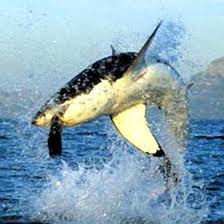
For reference – in this parallel, humans are that seal
Now, Great White Sharks are amazing, and badass, and the entire reason behind Discovery’s Shark Week. But like all apex predators, they are also inherently vulnerable because of this important fact – prey species must reproduce quickly, because it’s through sheer numbers and fecundity that the species can continue, since just about everything eats them (think bunnies here). But apex predators are different. For one thing, it usually takes them much longer than their prey to reach maturity – both physical maturity and then sexual maturity. After all, nothing is eating them, so what’s the rush? Secondly, they tend to reproduce less often, and in smaller numbers, because, again, no one is eating them, so no worries.
Which is fine… as long as nothing effects that ecosystem.
Here’s the thing about an apex predator – they are far more vulnerable to changes than their prey species. They are also far easier to wipe out, because of those important traits – slow to mature, slow to breed, and then they produce small numbers of offspring.
This takes us back to the badass Great White Shark. We don’t know a whole hell of a lot about them, but we do know that they live 30+ years, and that they don’t reach sexual maturity until around year 15. They also have an eleven-month gestation cycle, and deliver between 2 to 14 live pups, which then swim off and have to fend for themselves while they get bigger.
That long maturation period and relatively low amount of young makes them very vulnerable. For example, if suddenly another species comes along with boats and the interest in sport-fishing them and/or making tasty soup out of their fins, a huge dent can be made in the population, and this is a population that can’t bounce back very quickly.
And that led me to an idea I really liked – that vampires were a species that was barely hanging on, because the long maturation period and the low birth rate had been a disaster once humans began developing technology that could offset the natural power imbalance between them. Imagine a rabbit vs. a wolf. Now imagine if the rabbit is carrying a rabbit-sized AK-47. Those big teeth don’t make such a difference now, do they?
So vampires are strong, and powerful… but it takes them a while to get that way, just like baby Great White Shark. And if normal humans (the rabbits) traditionally reach sexual maturity around 15-18, then my vampires don’t hit it until they’re around 250. And the birthrate is very low – usually between one or two offspring in a regular vampire’s lifespan.
Now my primary vampire, Madeline Scott, is unusually fertile in the vampire world. Her oldest is Prudence, who was born in 1775. Then Chivalry in 1864. Then Fortitude, who is now 26. And none of her children are old enough to either leave home or start a family themselves, though Prudence is getting close.
To me, that seemed both interesting and plausible that this was a species that A) hadn’t overrun the entire world, and B) could be pushed right up to the edge of extinction.
But most importantly, C) would be neat to write about.
That was how I imagined I used the idea of vampires as apex predators to construct my species. But I also had a second way of interpreting vampires, which I’ll go into more next time –
Vampires are apex predators. But they also are very specific predators, feeding solely on the blood of another species. Which to me made them…
Parasites.

And this was when the vampire lifecycle started getting interesting…
10 Concrete Ways To Help After A Disaster
It’s hard to know what to do with yourself or how to feel after a disaster like this, which is why I think blog entries like this are so important. The Belle Jar has presented it beautifully, so just go ahead and read:

I was sipping an overpriced americano in a small, aggressively hip coffee shop today when the news broke about the bombing at the Boston Marathon. I’d only meant to sit down for a few minutes, but ended spending over two hours there nursing my cold coffee and obsessively refreshing my Twitter feed.
Sitting there, I had the surreal experience of watching a disaster unfold in real time on social media. What made it even more strange was the fact that I was surrounded by people who had no idea what was happening. Two girls across from me discussed their upcoming Vipassana retreat and had a passive aggressive competition about their current meditation practices. A girl next to me was reading The Feminist Porn Book and occasionally making furious notes in her Moleskine. A young boy and his grandmother seated on my other side tried to figure out his math homework.
View original post 1,369 more words
Guest blog
I’m guest blogging at The Qwillery today. This is a topic that I’ve actually spent a lot of time thinking about, which is “The Weaker Protagonist.”
At the start of Generation V, Fortitude Scott is a guy whose life is sucking and who has no intentions at all to be heroic. Forget saving the world, he’d just like his roommate to pay his half of the rent — and Fort can’t even make that happen. In an early chapter, Fort is mugged by Bruins fans.

In fairness, some Bruins fans can be dicks. But not you, of course. You are a Bruins fan for all the right reasons. Because of the skill and athleticism displayed in the sport. You sniff judgmentally at those who go just to see the enforcers beat someone up. You watch for the *strategy,* and drink only in moderation.
But that’s what I like about Fort — because he’s not some super-powerful guy who can wipe out continents with a thought while also practicing his kung fu that would make Chuck Norris weep. He’s a guy with a film degree and a minimum wage job, yet he’s thrust into circumstances where he chooses to act heroically.

So pre-order my book. And if you have moral objections to Amazon, it’s also available from Indiebound!
One month to liftoff!
You know that feeling you start getting when you are little and you’ve just finished off the last of the Thanksgiving turkey? The knowledge that in just a month, you are going to be running downstairs and seeing a pile of presents under the tree with your name on them?
That’s what this feels like. Giddiness, impatience, and the wish that you could just skip the next month.
You know that feeling you started getting when you were a senior in college, and the order form arrived for your graduation gown? That knowledge that in just a month, you were going to march in a line, wave to your family, and then be expected to find a job in order to start paying off those massive student loans?
That’s also what this feels like. Anticipation mixed with fluttery gut-deep nervousness, and a vague apprehension of what’s about to happen.
I’m simultaneously in two very different emotional landscapes. It took a lot of years and hard work to get to this moment, so I’m very intensely desperate to see the fulfillment of Generation V sitting on a bookstore shelf. On the other hand, I have that nervous worry – what if no one really likes my book? But then I remind myself that if the book truly sucked, then my editor wouldn’t have bought it in the first place. Plus, Devon Monk and Karen Chance both said very nice things about the book, and I never even met them! Which helps for five minutes until I start thinking about the possibility of seeing one-star ratings on Amazon.com. But then I think about how nice it would be to see five-star ratings.
It’s awesome and complicated at the same time.
Some good things:
The Goodreads giveaway of Generation V closes in two days! 25 copies of the book will be given away, and right now there are 627 people requesting – so that’s pretty cool.
Generation V got its first review! You can go over to RT Book Reviews to check it out – heads up, though – you can only see the review if you are a subscriber to the magazine. Two months after the print magazine hits the stands, everyone will be able to read the review, but for now you need to be able to log in. But I got a peek, and the reviewer, Bridget Keown, gave it four and a half stars out of five, which I am assured is a big deal for a debut! (and Keown used the word “sensational” to describe Generation V!)
I’ll be guest blogging at The Qwillery next week as part of their 2013 Debut Author Challenge, and there will also be an interview posted the day after Generation V hits the stands (May 7th!)
Finally, my author copies arrived – the book looks AMAZING! I’ve included pictures below! (oh, if you run a blog or a website and would like to review Generation V, please email me and I’ll send you a copy!)
It looks good coming…
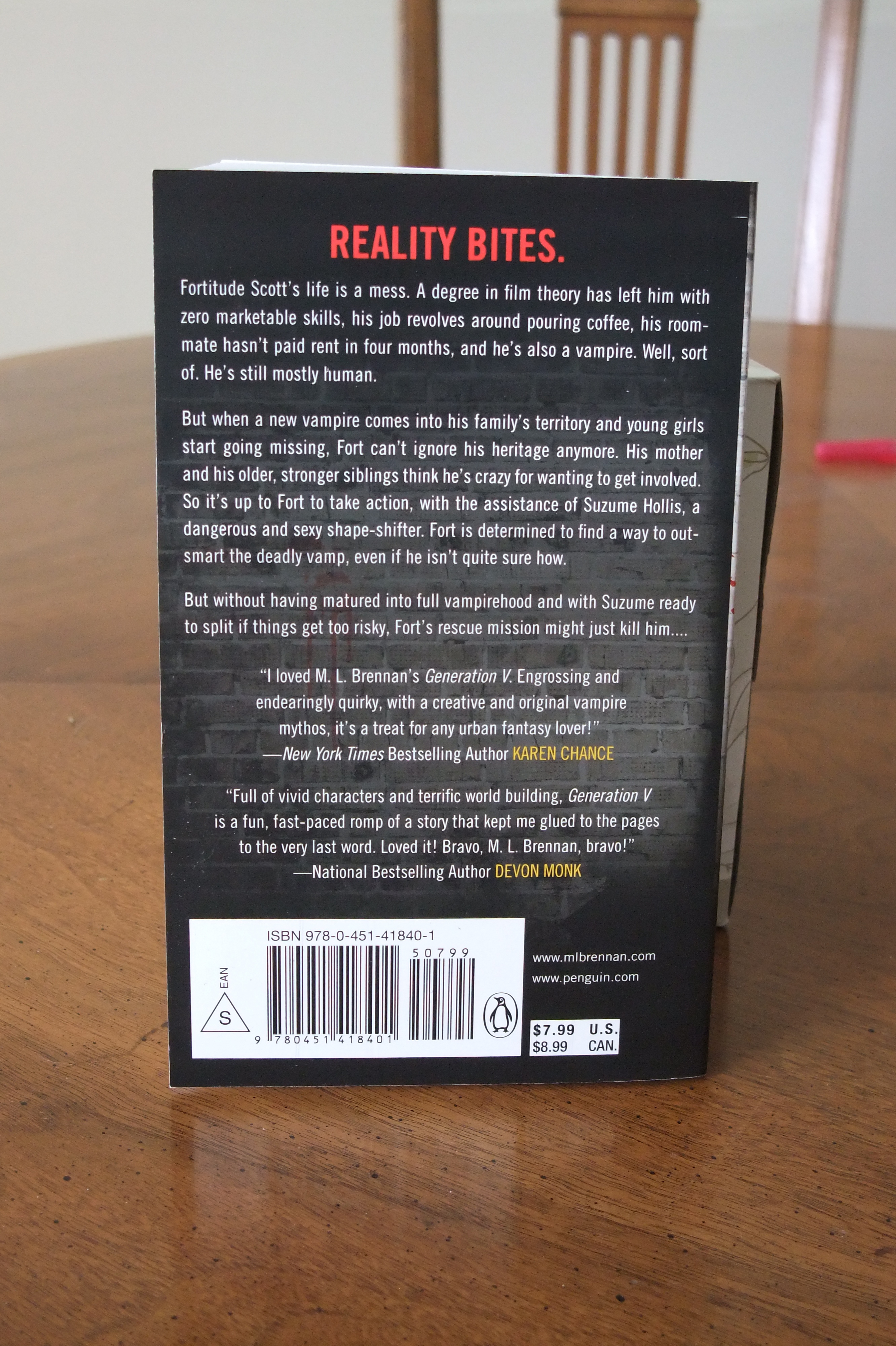
… and it looks good going!
 M. L. Brennan